By Jennifer Connor

Walking into Deborah Klotz’s recent show at the Maine Jewish Museum on Congress
Street in Portland was like taking in a breath of fresh air. The light and energy of her
exhibit Traces allows the viewer to see her process of reflection and meditation through
her work. The show consists of over 40 multi-media pieces that include sculpture and
prints. Many are shown on large metal panels that have a matte finish and lean against the
walls while others seem to float in the space.
Klotz’s mixed media pieces consist of glass, handmade papers, metals such as
steel and iron in the form of shavings or chain, fibers, magnets, ink, and pages of books.
These many diverse mediums flawlessly blend into one another with a calm energy that is
steeped deeply in reflection. Her use of cast laminated handmade papers create layers of
texture and are embossed over pieces of metal to create interesting shapes in the
two-dimensional surface of her Some Like Stone piece. In her Milk and Honey sculptures,
the use of crocheted wire creates a 3-dimensional forms that although made of metals
seem weightless while the cast glass and metal base grounds the pieces.
Klotz takes the viewer through her process and into her space of contemplation
and meditation that affected her process in creating this body of work. She explains in
her artist statement that Traces explores our relationship to the hidden and anonymous
by using processes and materials that make visible the quiet trails and meanderings of
thought and curiosity. What we are drawn to becomes the graphic lines and words we
draw, write, and speak. The process of object making (cast glass, magnetic papermaking,
wire weaving, clocks, extruded paper pulp) and image making (iron silk screens,
microscopic image collages) holds history and evidence of movement.

This is visible in her work Four Generations of a Journey by 36 Lamed Vovniks
in which she has taken 144 pages of Dante’s Inferno, Paradise, and Purgatory. She has
reread the pages and notes made by herself years ago while studying at Brandeis
University. She then journals by creating organic forms and lines over the rigid text using
ink, pen, and paints to create images in layers on the pages. These shapes and lines create
movement on the book pages. This body of work has been ongoing since 2011 is shown
at the back of the museum on the walls along the staircases. Each simply framed piece is
thoughtfully placed in a stacked formation following the lines of the steps. Through
thought and curiosity she gives new life to something once forgotten.
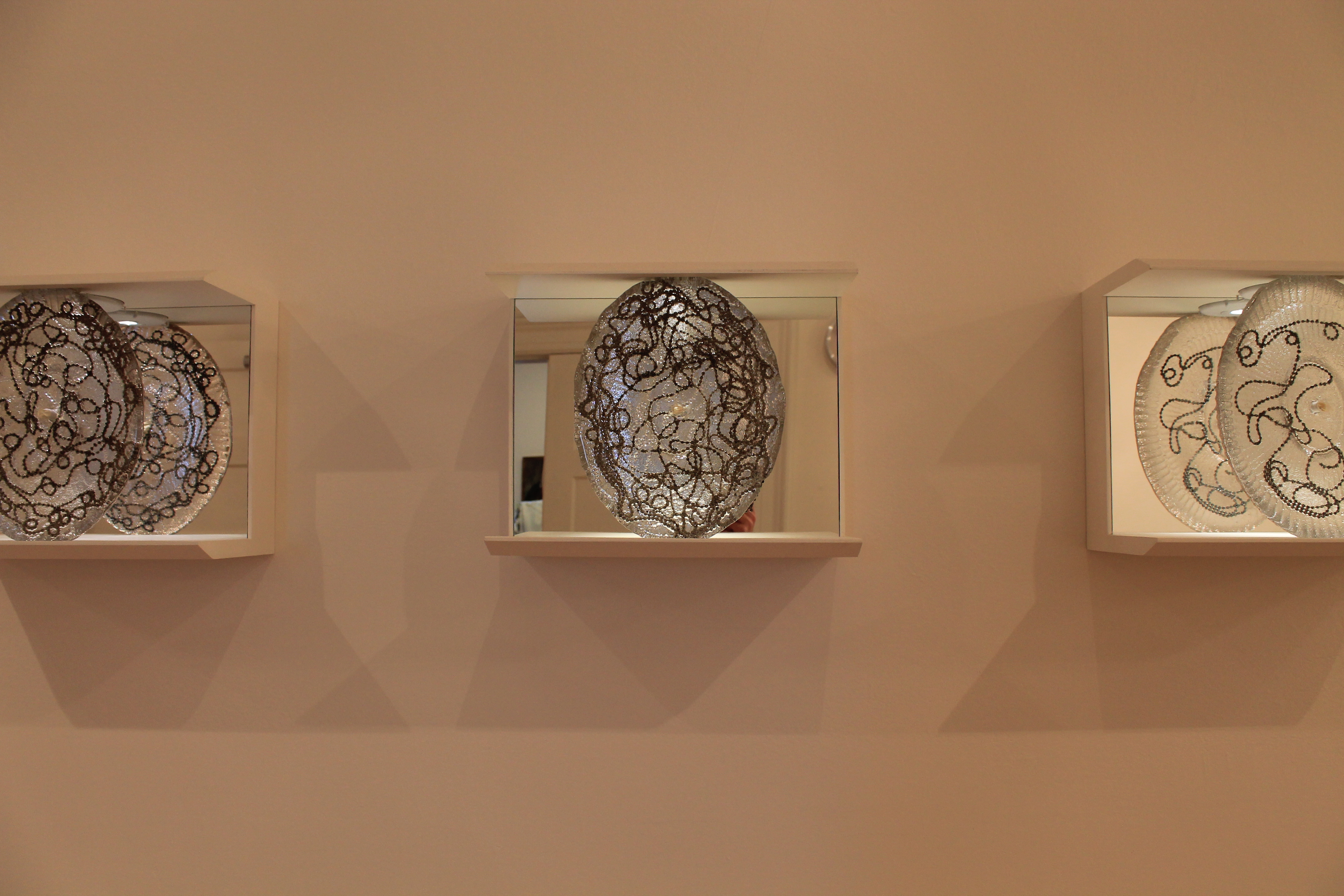
A part of the work worthy of attention is the Trace/Trail series of sand-cast glass
sculptures with beaded steel chain embedded beneath the surface. These oval shaped
pieces gracefully stand in mirrored wall mounts. The side facing the viewer is smooth yet
the lighting allows us to see the incredible texture, bubbles, and movement of the chain
inside the glass. Defying gravity, they seem to float in the light.
As I rounded the corner, Klotz’s amorphic print series captured my attention. She
uses magnetic metal filings to create organic, original shapes on squares of paper. With
each print being held by tiny magnets on a large metal panel that leans against the wall.
The shape and texture of this grouping urged me to linger in front of them. I continually
found myself revisiting them to study and reflect on what they had to share.
Klotz’s use and repetition of shapes and materials in her work creates a closely-knit, cohesive exhibit.
The works connect to one another in the process of sustaining a body of work where the whole is greater than the sum of its parts.
The pieces have a similar feel with consistent color, materials, and organic shapes are seen again and again yet in a new light or
with new eyes. Traces is a body of work for a vast range of art viewers interested in well crafted, contemporary art.
Deborah Klotz teaches 3-D design here at SMCC and also teaches at
Massachusetts College of Art. She received her MFA from the Massachusetts College of
Art in 3-dimensional sculpture.
Categories: Arts & Culture
 The SMCC Beacon