
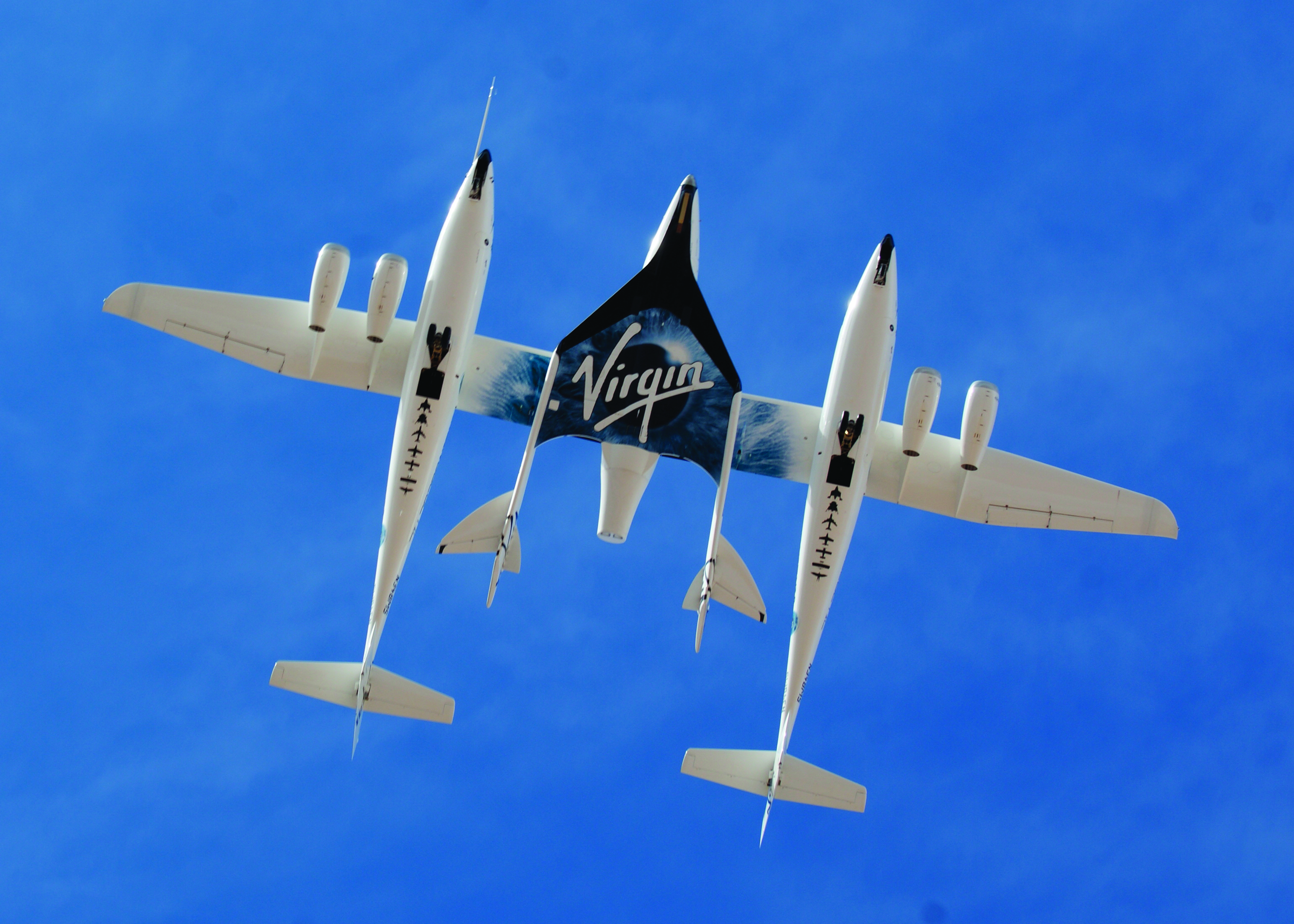
White Knight Two, Image: Wikimedia Commons
By Jason Glynn
When pushing the boundaries there is bound to be some setbacks, in addition to success. Even though NASA’s heydays is now in the past, the race to know the unknown hasn’t slowed down. In just over a month four space programs made the news: the Antares rocket launch on Oct. 28th was a failure, as was a recent Virgin Galactic trial, the Philae lander was a huge success, and Russia’s recent launch remains a mystery.
On Oct 28, a Soviet-made Antares rocket operated by private company Orbital Sciences exploded six-seconds after launching. After “catastrophic failures” engineers self-destructed the rocket. The company is contracted by NASA to resupply the International Space Station [ISS]; despite much criticism to using antiquated 1970s Soviet tech. NASA said “hundreds of millions of dollars of equipment, ranging from classified cryptographic gear to school science experiments” were destroyed.
I have long been saddened by NASA’s continuous budget cuts. Without our own space shuttle program, we are forced to rely on private companies – or the Russians themselves – for rides to the ISS. Without the ingenuity of NASA, or power of the government, private companies must either find their own technology, or borrow others, such as Russia’s.
Three days later, on Oct 31, Virgin Galactic’s VSS Enterprise crashed in the Mojave Desert after breaking apart in-air during a test flight. The spacecraft was the first of five SpaceShip Two models planned. Sir Richard Branson, billionaire owner of Virgin Mobile and Jet Blue, started Virgin Galactic to offer commercial space services and suborbital space tourism. The cause of the crash that took the life of a test pilot is said to be a malfunction with the feathering system, essentially an airbrake.
Although the SpaceShip Two’s have their own rocket, it is brought to about 50,000 feet under the WhiteKnight Two, a modified dual-fuselage commercial airliner before it is released. Then SpaceShip Two engages its rocket to propel up to 360,000 feet, just beyond the defined boundary of space. Tickets are sold for $250,000 USD and numerous celebs have made deposits, including: Katy Perry, Stephen Hawking, Brad Pitt, and Tom Hanks.
The Philae Lander is part of the European Space Agency’s Rosetta Spacecraft, which has been on a 10 year journey to find a comet and examine its composition. We have crashed into comets previously, but this was the first “soft” landing. However, this “soft” landing was a bit bouncy, and the harpoons failed to launch in order to secure it to the comet. After landing Philae sent out a tweet on Nov 12 from 310 million miles away that said “Touchdown!! My new address: 67P!” 67P was the unromantic name given to the comet.
Since comets have very low gravity, it is important to be secured so it doesn’t fly off to outer space. Thankfully, when the lander bounced as it came to rest near an icy cliff that holding it in place; yet unfortunately, this icy cliff is also blocking its main solar panel. This has obviously had an effect on Philae’s operations and experiments, with it going silent shortly thereafter. The ESA expects to be powered back up once the orbit approaches the sun.
It has just come to light that Russia snuck an unknown object onto a satellite launch back in May. Experts fear what’s been dubbed as Object 2014-28E could be a “satellite killer.” The object was launched with three other Rodnik communications satellites and was originally thought to be space debris until it started making strange maneuvers.
However, this could also be something intended to repair damaged satellites or even remove space junk. Russia has not commented and with relations between them and the West souring over the Ukrainian crises, some fear they have continued the once-shelved Istrebitel Sputnikov, or “satellite killer” program. So far the object has only been tracked moving towards other Russian equipment; but if it were a satellite killer, it could certainly wreak some havoc with its foes if needed.
The journey to explore space is just as arduous as it is fascinating. There will be ups and downs, setbacks and leaps ahead. If we ever want to find our origins we need to look at where it all began. As we keep heading to infinity and beyond, one thing will remain certain: what we don’t know is as vast as space itself.
Categories: Uncategorized
 The SMCC Beacon