By Jeff Toorish

Author on the banks of the Zambezi, preparing to climb back up the gorge.
Photo
Philip Smethurst
Livingstone, Zambia – The trip into the gorge is nearly 700 feet, practically straight down. At the
bottom is the mighty Zambezi River. There is not much of a path, more a series of crumbling
rocks and slippery dirt. The nearest town is called Nsongwe, mostly stick huts with thatched
roofs. The people who live there can hike down the gorge in about ten minutes, barefoot. It took
me nearly two hours, wearing boots. I don’t think I’ve ever sweated so much.
I was in Zambia to teach emergency wilderness medicine and survival to Christian
missionaries. But a large part of my job was to photographically document the expedition.
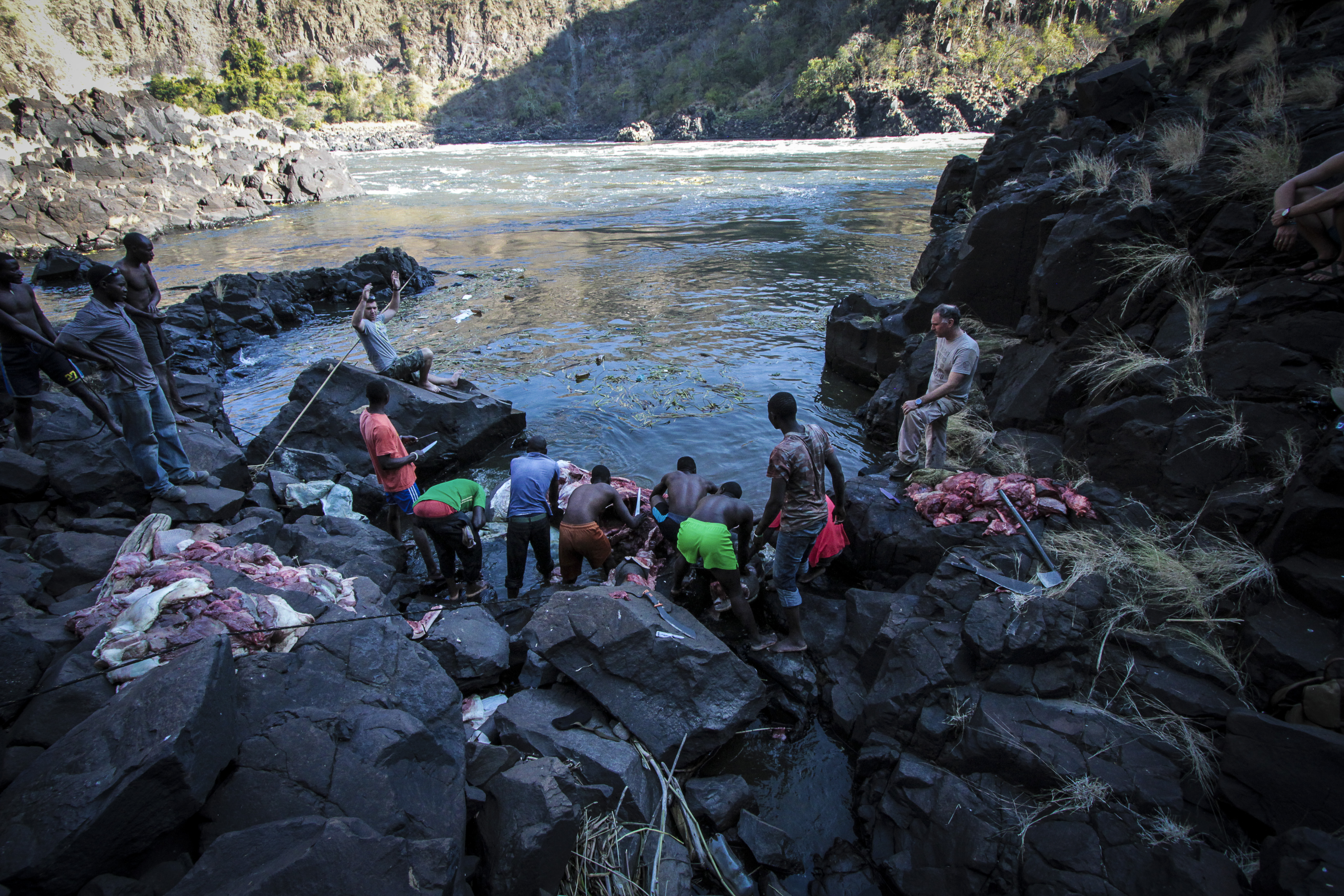
Another instructor, a former African hunting guide, spotted a dead hippopotamus that had fallen
over Victoria Falls and settled below our classroom at a spot called Rapid 14. My job was to hike
down the gorge to take pictures and video of the Nsongwe residents as they butchered the animal
for much needed protein.

Author teaching in classroom perched 700 feet over the Zambezi River.
Photo
Tony Meiklejohn
My incentive was hippo stew for dinner.
Let me begin with a confession. Unlike many of my former classmates at SMCC and
colleagues in emergency medicine, I was never really interested in being a firefighter. In point of
fact, I didn’t really contemplate working as a paramedic in the back of an ambulance when I
decided to attend paramedic school.
I originally became an EMT because of my involvement in underwater cave exploration
with a team of elite divers based primarily in central Florida. We hunted Mayan relics mostly in
caves. Our expeditions normally lead to some very remote diving and climbing which has the
potential for serious injuries. One day it occurred to me that while we had a paramedic on the
team, we didn’t really have a reasonable plan if he became injured or sick. When I asked him
about that, he said if that ever happened, he hoped he’d be conscious enough to tell us what to
do. That didn’t sound like a very good plan.

Rafting the Zambezi River, this is Rapid 18 which normally capsizes 95 percent of rafts. Author in
front of raft.
Photo
SafPar Rafting
The next day I enrolled in an EMT course at SMCC. I loved it, and in short order became
a wilderness EMT. Then I enrolled in the SMCC Paramedic Program, eventually becoming an
instructor at the suggestion of Eric Wellman and Scott Cook, two of my teachers at SMCC.
After Paramedic School, I applied to SOLO Schools in Conway, NH, for their high-level
GeoMedic course. This program designed to equip people with medical training to work in
remote areas as a provider of definitive care. In other words, to work in a situation where there is
no hospital, no golden hour, and no ambulance coming.

Leopard, Chobe National Park, Botswana. Observing leopards is relatively rare because they tend to
stay hidden during the day. They often attack baboons at night.
Photo
Jeff Toorish
At the invitation of the senior staff, I wound up taking SOLO’s first ever instructor course
as well as GeoMedic, spending nearly a month in Conway at a location called Tasker Hill in sub-
zero temperatures where I learned everything from suturing wounds, to navigating by compass in
harsh conditions to avoiding being kidnapped by terrorists.
All that is what led me to hiking down an incredibly steep gorge in Zambia to take photos
and videos of people cutting the edible meat from a dead hippo.

Zebras and elephants, Chobe National Park, Botswana.
Photo
Jeff Toorish
One question I am often asked is, how does one go about getting involved in this type of
international teaching and expeditionary work? In my case, the answer is education, and
normally that involves some type of advanced training, possibly in more than one discipline. But
all that education begins with something simple; I learned how to scuba dive, then I increased
my training to become a cave diver. Because I have a background in photography and video
production, that made me more valuable to expeditions that were looking for people to document
their work. Gaining medical training and eventually a degree in paramedicine from SMCC had
the same effect. Becoming certified as an EMS instructor/coordinator helped as well.

Giraffe, Chobe National Park, Botswana.
Photo
Jeff Toorish
I’ve been to Africa twice this year, once in June and recently returned from the second
trip. During the next year I may return to Africa. I have also been asked to participate in a
medical expedition to Nepal and a research trip down the Amazon River. But none of that would
have been possible without gaining the necessary knowledge and training. Degrees from schools
like SMCC are often the first step, or a place for continuing education.

Bull Elephant covered in mud to help ward off the hot African sun. Chobe National Park, Botswana.
Photo Jeff Toorish
If I was to give one piece of advice, it would be to never stop learning. Make it your
priority to learn something brand new every year because you never know where it will lead;
maybe even down a gorge in Zambia to watch a hippo being butchered.
We never did get any hippo stew.
Jeff Toorish is a graduate of the SMCC Paramedic Program and an adjunct instructor at SMCC.

Crocodile along the banks of the Chobe river in Botswana. This croc was about six feet long.
Photo
Jeff Toorish
He is a National Fellow in The Explorers Club. You can read more about his exploration and see
photos and videos, including a video of white water rafting at his blog, jefftoorish.tumblr.com.
—
Categories: Uncategorized
 The SMCC Beacon