
Infographic by Elizabeth Barrett
By Elizabeth Barrett
Ahh, corn. What food staple brings more fond childhood memories than corn on the cob during a summer cookout? Unfortunately, in the past few decades, corn has been turned into a genetically modified, environmentally damaging super crop, more of a system than a staple. While this industrialization of corn agriculture has been praised for fueling the economy and providing food for more people, in reality, most of the corn grown in America doesn’t go to the mouths of its citizens, and its production may be doing much more damage than it’s worth.
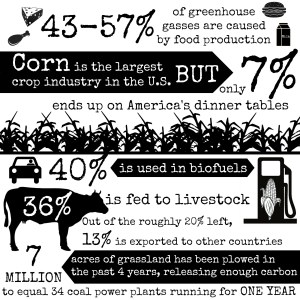
There has been a lot of discussion in recent years about industrialized agriculture, farming and food production, and how it has impacted climate change. In fact, food production as a whole contributes to between 43-57% of man-made greenhouse gas emissions, according to the UN. When considering the sources of these gasses, one of the biggest contributors is corn. Corn is our nation’s largest crop industry, followed closely by soy. However, barely any of this corn goes toward actually feeding people, and a majority of the corn that is produced for food is in the form of high fructose corn syrup.
According to researchers at the University of Wisconsin-Madison, 7 million acres of new land have been plowed in the past four years for both corn and soy crops. When new land is plowed, it releases carbon dioxide into the atmosphere. The amount of carbon dioxide released from these 7 million acres has been estimated to equal that of 34 coal-fired power plants, running for one year. This is happening in a time span when our nation’s leader is calling for action to reduce carbon emissions.
After plowing, soil is heavily fertilized with nitrogen-based fertilizers, which release nitrous oxide into the air along with the carbon. Corn is then planted and doused with many different chemicals and pesticides, which seep into the soil and leech into surrounding water supplies. There have been numerous studies over the years highlighting the negative effects that these processes and toxins are having not just on the land, but on the people working with the corn. There is also concern over the health of the animals that are consuming it.
The meat industry is one of largest consumers of the corn grown in the U.S. The Scientific American points out that roughly 36% of the corn grown here goes to feeding animals for us to eat. The meat industry brings along its own range of problems, including another major contribution to greenhouse gasses – methane from animal gas and waste.
So do we eat the rest of the corn that is produced? No, in fact, a whopping 40% of corn produced in the U.S. goes to the bio-fuel industry, specifically ethanol. Corn-based ethanol bio-fuel has been pushed as a more environmentally friendly approach to fuel, and the Obama administration has called for even more production in the last few years. Ironically, the Environmental Working Group published a study in 2014 that suggests that ethanol-blended fuel may be worse for the environment than gasoline, when production is taken into account. Releasing carbon dioxide in an attempt to create less carbon doesn’t seem to make sense, does it?
So if nearly 80% of the corn produced in America goes to cattle and fuel, the rest has to get to our plates, right? Not quite. Out of the remaining 20% of corn, about 13% of that is exported to other countries. We are then left with 7. 7% of the country’s largest agricultural product, which goes toward food for the American people, and the majority of that is, again, in the form of high fructose corn syrup, which has its own negative reputation. Sure, in some way, we still consume it, since it’s fed to our livestock, but animals are not meant to eat corn; this has been shown to cause health issues in animals, including loss of calories, protein, and vital nutrients that humans are supposed to get from their meat.
Genetic modifications and farming techniques have made corn one of the cheapest crops to grow and profit from. It has been processed to create many food items which make our lives easier, as well as provide a cheaper means for feeding livestock. But knowing all the risks and damage it’s causing begs the question – is it worth it?
Categories: Uncategorized
 The SMCC Beacon