
By Dale Rappaneau
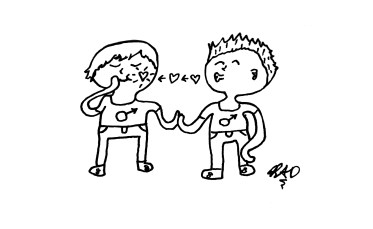
My best friend is gay. I know he’s gay because he and his wife sat down with my fiancée and me to tell us about his realization of being gay. They had been married for two years, together for just six months before their wedding, and their relationship had been plagued with sexual issues. One evening she finally asked him, “Are you gay?” Being our closest friends, they felt it necessary to inform us of his answer, because they wanted to give us context for whatever changes would occur in consequence of his admitted homosexuality.
When the husband and wife met, they were both religious in a broad sense. They went to church, they led children’s groups, they followed religious dogma, they believed in the goodness of church, and so forth. However, as their relationship has deteriorated since the husband admitted his homosexuality, religion has become a divergent topic. The husband blames his religious upbringing for his inability to accept himself, whereas the wife has dug her heels into religion as a rock to ride out the storm. Out of fear and passivity, the husband will not ask for a divorce, despite the obvious signs of pain and suffering caused by their continued life together, nor will the wife’s religious beliefs allow her to ask for a divorce.
From an act-utilitarian perspective, it’s clear they need to end their relationship and move on to greener pastures. The husband wants to live his life as a gay man. He admits to having made a mistake in marrying his wife. He admits to having been confused and disoriented, in a state of constant suppression of his sexuality to adhere to religious dogma. He is suffering and in pain. Leaving the marriage would alleviate the negativity.
More than that, it would stop the overflow of negativity from their relationship into the lives of others, as it’s clear to many around them that they are degrading into shallower creatures. They talk less. They socialize less. They have slowed participating in charitable activities and events. The wife’s health has deteriorated due to stress and worry. They are shadows of their former glory, because they are focused on the falsehood of their relationship.
From a rule-utilitarian perspective, however, it gets a little more muddled. In “Consider Ethics,” author and philosopher Bruce Waller writes, “In order to determine what really maximizes pleasure and minimizes suffering, we must look more deeply at societal practices and institutions.” Marriage is both a practice and an institution.
When they were married, they agreed to be together until death. They made vows before God. They testified their love in ritual and act. Now, although the husband is realizing it to be a mistake and therefore suffering because of it, the wife desires commitment to her marriage vow. For her, divorce would result in pain and suffering so deep to the core of her religious identity, it may never heal. Yes, she is currently suffering, she has admitted as much to my fiancée and I, but a rule-utilitarian may argue that the immediate pain does not outweigh the prolonged pain of weakening marriage as an institution. Or as Waller puts it, “If people could break promises whenever a more appealing or pleasurable option comes along, then the whole purpose and practice of promising would be destroyed.”
So, what do they do?
Satisficing consequentialism, a more timid version of utilitarianism, would argue they should do what’s “good enough.” But in the face of this situation, what does that mean? The wife wants to remain in her marriage for the sake of sanctimony, but the husband wants to follow his desires and identity. The “good enough” outcome seems to be a mix of the two, resulting in a marriage that allows the husband to explore his homosexuality in some agreed-upon capacity. Maybe they open their relationship to bisexual or homosexual men. Maybe the wife takes a heterosexual lover. Maybe they find some happy alternative within their relationship.
From my perspective, I can only guess, but the evidence points to an inability for them to compromise on a “good enough” outcome, since the wife continues to react negatively to the husband’s attempts to express his homosexuality. When he bought rainbow-colored boxers, which he saw as a private and personal way to feel connected to gay culture, the wife cried. When he spends alone time with heterosexual male friends (including myself), the wife becomes jealous and defensive.
The wife thought she was marrying a heterosexual man — a man who promised her a life of commitment, of love, of togetherness before the eyes of God — and she now feels like his homosexuality is tearing her world apart. She feels cheated, as if he lied to, which in a way is true: He admits to having married her as an attempt to forever suppress his homosexual tendencies, to keep in accordance to religious pressure, and made the mistake of involving her in his sexual confusion. But must he forever pay for this mistake? Must she? What if there is no “good enough” outcome?
As a close friend of the couple in question, the only realistic solution I can see would be act-utilitarian in nature: the couple divorces. They are not happy. They have not been happy for years, long before the husband admitted his homosexuality. The husband has become secretive and the wife has become possessive.
There is no happy ending for this relationship. Rather than continue the suffering and pain, which is spreading into the lives of those they interact with, they should take the necessary steps to move toward individual lives, separate from each other and the unfortunate situation. In the end, the positive consequences of their actions would outweigh the negativity involved in separating themselves from each other and the institution of marriage.
Categories: Calendar
 The SMCC Beacon