
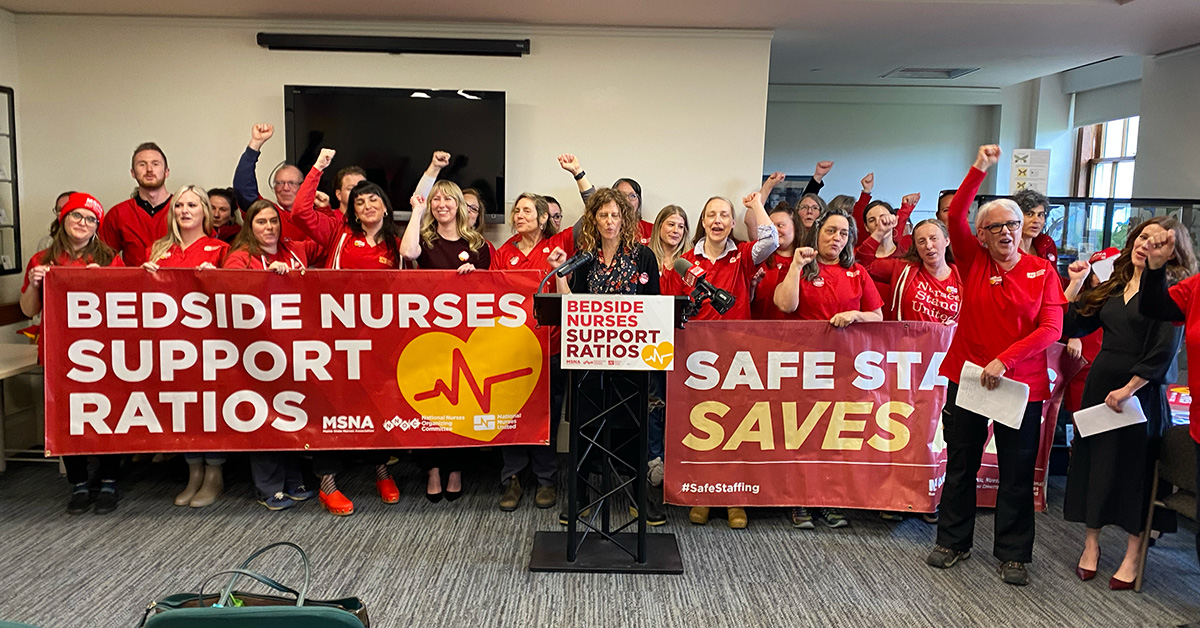
Maine nurses are backing the Maine Quality Care Act, which is on its way to the House awaiting approval. The bill (LD 1639), passed on March 27th by the Maine Senate, will limit the number of patients that nurses are required to care for during their shifts. The amendment seeks to relieve the taskwork of nurses, creating an environment for less burnout and more quality, intensive care to their patients.
“Maine nurses need meaningful support in the form of legislation, and that’s a real possibility with LD 1639.” – Sadie Tirrell, RN (via Portland Press Herald)
As it stands, there is no official law in Maine that limits the number of patients a nurse can care for during a shift. The Maine Quality Care Act, sponsored by Sen. Stacy Brenner, would install a mandated minimum nurse-to-patient ratio. According to the bill, controlled nurse-to-patient ratios will “save lives”, a claim based on a 2021 study conducted by Karen B. Lasater suggesting that lower patient-loads are directly associated with lower mortality rates in hospitals. The bill offers other protective measures, including the protection of a nurses’ right to advocate for the specific interest of their patients, and the protection of nurse-whistleblowers who speak out against harmful administrators and assignments. If passed, hospitals will be required to publicly disclose their nurse-to-patient ratios. The bill would authorize the Maine Department of Health and Human Services (DHHS) to enforce such mandates, with $10,000 fines to hospitals that do not adhere to the mandate.

Research would, in fact, support the idea that mandated ratios benefit both the nurse and patient: according to Karen Rosenberg’s 2021 study, “minimum nurse-to-patient staffing ratios not only improve nurse staffing and patient outcomes, but also yield a good return on investment. Staffing improvements of one fewer patient per nurse led to improvements in mortality, readmissions, and length of stay.”
However, with any push for legislative change comes its counterpoint, and concerns have been heavily voiced. In a public Senate hearing, Margaret McRae, RN objected to LD 1639, suggesting that the bill’s limitations will gravely impact “nurse autonomy”. McRae has faith in what’s known as the ‘Nursing Process’, which is a nurse’s ability to determine the best assignment for their respective patients. McRae — and others — feels that LD 1639 does not take into account the unique needs and circumstances of each patient, which should ultimately be determined by a nurse’s professional insight. McRae concluded her statement by saying that healthcare institutions would have to “reduce bed capacity” in order to maintain the legislated ratios, which could halt a patient’s access to care. Melodie Greene, a Maine psychologist, shares this concern, stating that LD 1639 is a “bad deal” for the state of Maine. In a Portland Press Herald article, Greene wrote: “Although enforcing strict nurse-to-patient ratios sounds ideal, it could force health care facilities that couldn’t comply to close beds or divert ambulances”.

In fact, that same Senate hearing (held on May 4th, 2023) consisted mainly of opposing voices. Of the 59 total hearings, 37 were in opposition of the bill; 20 were in favor, and 2 were neutral (neither for nor against). In other words, 63% of the participants were against the passing of LD 1639. Despite this, the bill would pass on a 22-13 floor vote about one year later.
Mary Beth DiFilippo, the Chief Nursing Officer for the MaineHealth Mountain Region, strongly opposes LD 1639 in defense of rural hospitals. She references Stephens Memorial Hospital in Norway, Maine, which has absorbed a great deal of patients as rural hospitals continue to close across the state. “[The bill] would unnecessarily force rural hospitals, like Stephens, to cap access to care. Our emergency room nurses, for example, would have to limit the number of patients they could care for, creating long waits and crowded waiting rooms, and even delays in care.”
Kevin Carelton, former Western-Maine Healthcare board member, continues McRae and DiFilipo’s sentiment: in an article, Carelton wrote: “The bill would put the exact number of nurses required to staff hospital units, regardless of patient acuity, nurse experience, or any of the other factors our nurse leaders use to decide how to provide excellent patient care”.

National Nurses United (NNU) — the country’s largest RN union organization — sought to refute many of these points in defense of LD 1639. In a “Myths vs. Facts” info-site, NNU states: “The number of patients assigned to a nurse directly impacts our ability to appropriately assess, monitor, care for, and safely discharge our patients. When nurses have fewer patients to care for, we have more time to care for each patient.”
In terms of the ratio-bill removing “nurse autonomy”, NNU had this to say in response: “Safe staffing ratios set a minimum standard based on research, evidence, and best practices. Ratios will provide a safe minimum level of staffing. Hospitals will still have flexibility in staffing – but they cannot go below the levels that the research demonstrates are safe. The truth is that when there are more RNs onsite, hospitals are better prepared to respond to unexpected situations.”
In response to concerns about the bill creating profit cuts, NNU referenced California’s success, which implemented their own nurse-to-patient ratio mandate back in 1999. “Not one California hospital closed because of ratio implementation”, says NNU. “In California, hospital income rose dramatically after ratios were implemented.” Studies from the National Library of Medicine (NLM) would support this claim, saying that California hospitals have continuously exhibited economic growth during recessions, suggesting that hospitals have not seen a loss in patient numbers, despite the mandated ratio.
And, in response to concerns surrounding the nursing shortage, NNU says that “Maine has more RNs working today than at any time in the past. Maine also has a massive surplus of licensed RNs who are not working because of unsafe staffing and their inability to provide all the care their patients need. Safe staffing ratios will bring nurses back to the bedside.” As mentioned earlier, DiFilipo voiced concerns that nurse unemployment numbers will not be able to support the ratio mandate. NNU, on the other hand, feels that a ratio implementation is just what Maine needs to incentivize employment, because it promises a safe and manageable work-environment.

Proponents of LD 1639 feel that the ratio-mandate is essential to a functioning work environment, putting both nurse and patient needs first. With less patients assigned at once, nurses would be able to deliver more quality care, ensuring better overall treatment for everyone. Arthur Phillips, an analyst for the Maine Center for Economic Policy, summed up this point in the May 4th Senate hearing: “Common sense and economic research tell us patients are less likely to get the care they need when health care professionals are stretched too thin. But in recent years we have lost lots of hospital nurses as they have been exposed to trauma and burnout.” A ratio mandate could be the solution for this predicament.
On the other hand, opposers fear that LD 1639 removes a nurse’s ability to make personalized decisions based on the specific needs of a patient. For example: one nurse’s assignment of six patients might be an entirely unique circumstance depending on the ailments and needs of said patients. In the opposer’s opinion, a mandate does not consider such intricacies. Opposers feel that this sort of decision should be up to nurses and their administrators; they’re confident in the system as it currently stands. Sharon Baughman, the Chief Nursing Officer for MaineHealth, said in a senate hearing: “…don’t strip nurses of their autonomy, don’t reduce nurses to a number, don’t further reduce access to care in our rural areas”.
Indeed, a great deal of the discourse appears to stem from the city vs. rural-hospital distinction. With a larger volume of patients being admitted in Maine’s urban areas, it makes sense that city-hospitals are pushing for the legislation of LD 1639, hoping for some kind of structure in the patient-assignment process. Rural-hospitals, who experience a lesser influx of patients, greatly value their staff’s ability to make flexible and adaptable decisions, viewing a legislative change as restrictive rather than helpful.
————————————————————————————————————————————————————————————————-
As of today, LD 1639 is on its way to the U.S. House pending official legislation. Supporters of the bill successfully convinced the Maine Senate that a ratio-mandate would greatly benefit Maine hospitals and its staff. Now, thousands of nurses and administrators throughout the state cross their fingers as the bill goes under review — both in support and opposition.
Categories: State Politics
 The SMCC Beacon