The ship built in the Titanic’s shadow now moves center stage
Photograph: https://commons.wikimedia.org
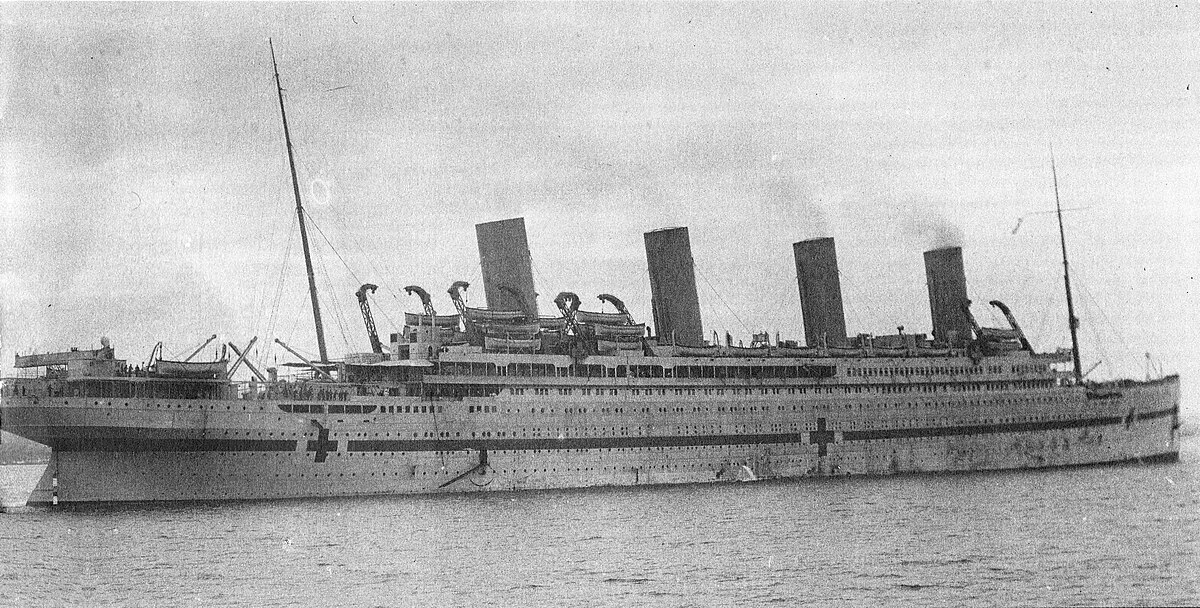
Everyone knows the story of Titanic, the ship that famously sank in April of 1912 during her maiden voyage from Southampton, England to New York City with a glittering passenger list that included names like Astor, Guggenheim, and Strauss. Of the nearly 2,200 passengers and crew, roughly 1,500 tragically lost their lives as the ship went down. But did you know that there were three “Titanics?” Indeed, Titanic was the second of three nearly identical ships planned by the White Star Line and its parent corporation IMM (International Mercantile Marine.) The first was Olympic (1910), the second was Titanic (1911) and the third was Britannic (1914.) With these three vessels, White Star Line hoped they would capture the Atlantic market from their competitor Cunard Line which had the Lusitania (1906) and Mauretania (1907.) White Star’s dreams were dashed when the Titanic sank, then again when WWI broke out in August of 1914. The British government requisitioned the just-finished Britannic to be used as a hospital ship before she ever received a paying passenger. Her prefix “RMS” (Royal Mail Ship) was replaced with “HMHS” (His Majesty’s Hospital Ship,) and she was painted white with a green band and three large red crosses down each side. In November of 1916, while sailing through the Aegean Sea to pick up wounded soldiers from Greece for transport back to England, she hit a mine and sank in 55 minutes with the loss of 30 of the 1,066 onboard.
Photograph: https://commons.wikimedia.org
Now, for the first time, a group of undersea explorers under the supervision of the Greek Ministry of Culture, and sponsored by British historian Simon Mills and his Britannic Foundation have recovered artifacts from the wreck. While Titanic has had considerable artifact recovery, this is the first time artifacts from Britannic have been sought. Public interest in the Britannic has increased due to related desires for the posterity of her history and preservation. The ship’s identity as the “Big Sister of the Titanic” also spurred this expedition. Britannic began her career with a 1915 voyage to participate in the recovery of wounded soldiers from the Dardanelles Campaign. After being returned to White Star, then requisitioned a second time, Britannic set sail from Southampton, England on November 12th, 1916, for Lemnos, Greece to aid wounded soldiers of the Middle Eastern theatre. She passed through the Strait of Gibraltar on November 15th and arrived in Naples on the 17th to take on coal and water. Due to a storm she departed a day late on November 20 for Greece. Breakfast was being served the next day when, at 8:12 am European Eastern Time, Britannic hit an undersea mine. As there were no patients yet onboard to evacuate, the nursing staff returned to their quarters to retrieve their lifejackets and headed to their emergency stations on deck. Titanic had carried only 20 lifeboats, but Britannic had 48. Despite improved safety features in the wake of Titanic’s loss, warpage of the hull from the blast prevented watertight doors from closing fully, and portholes left open by nurses to ventilate the wards prior to her arrival in Lemnos expedited the sinking. She went down in only 55 minutes, about 1 hour and 45 minutes shorter than the Titanic.
However, despite the much shorter sinking timeline, only 30 people died. Most of those casualties had been loaded into lifeboats that were launched without the captain’s permission and were subsequently sucked into the ship’s half-exposed and still-turning propellers. The wreck lay undisturbed for 59 years until it was discovered by French oceanographer Jacques Cousteau in 1975, lying on its starboard (right) side in just under 400 feet (121m) of water. Compared to the Titanic, which lies upright in two pieces and has begun to rapidly deteriorate in recent decades, Britannic is in one piece and remarkably intact. The 11-man expedition, which took place between May 6 to 13, 2025, recovered items that include the ship’s bell, a pair of binoculars, ceramic wall tiles from the ship’s Turkish baths, a navigation lamp, and objects from first and second-class cabins. News of this expedition’s success broke just last week when the Greek Ministry of Culture confirmed the retrieval of the artifacts during Mills’s expedition. The team used bags of air to carefully raise the 108 year old items to the surface, then they were placed in containers and cleansed thoroughly of any marine organisms. Currently the artifacts have been transferred to the Ephorate of Antiquities of the City of Athens where trained specialists shall continue conservation work. Eventually, they will be put on display at the National Museum of Underwater Antiquities in Piraeus.
Categories: Education
 The SMCC Beacon
