
The South Portland city council unanimously approved a resolution on February 4 formally asking Maine’s congresspeople to urge the federal agencies Immigration and Customs Enforcement (ICE) and Department of Homeland Security (DHS) to provide transparency regarding Operation Catch of the Day, an ongoing joint operation with a stated goal of detaining and deporting undocumented immigrants across Maine.
ICE officials announced on January 28 that since the start of the operation one week earlier, they had detained 206 people from a list of 1,400 Mainers whom they described as “the worst of the worst criminal illegal aliens.” Bangor Daily News reported evidence found in court records and press releases showing that out of the 67 detainees they could identify, 58 lacked a criminal record that could be independently verified. In the South Portland city council’s February 4 resolution, officials say “the City of South Portland recognizes and respects the role of federal authorities in enforcing federal law, but also affirms that public safety is best served through transparency [and] accountability,” and note that they both acknowledge the fear residents experience due to ICE activity in the community and confirm their commitment to the safety and dignity of the city’s residents.
Protests condemning the increased presence of ICE in major cities have swept the nation, most notably after the killings of Renée Nicole Good and Alex Pretti by ICE agents in Minneapolis on January 7 and 24, respectively. Portland has been home to multiple protests of this nature, with over 1,000 people gathering in Monument Square on January 30. On that same day, tens of thousands of people gathered in the streets of downtown Minneapolis, organized by student unions at the University of Minnesota.
Operation Catch of the Day is part of a crackdown from the Trump administration regarding undocumented immigration, one of Trump’s central campaign promises. Since Donald Trump’s inauguration in January 2025, there have been five large-scale immigration enforcement operations in cities across the country, the largest of which occurred in Minneapolis, involving an estimated 2,700 agents and resulting in 3,000 arrests. Minnesota’s response, particularly in Minneapolis, offers a possible blueprint for how Maine communities might respond.
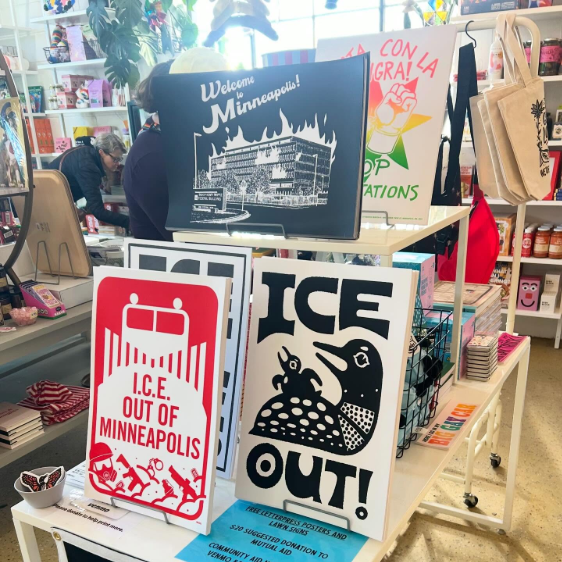
In response to Operation Metro Surge, residents of the Minneapolis area—including both local businesses and city governments—banded together to provide support for their neighbors. Minneapolis schools extended their opportunity for virtual learning, allowing flexibility for young learners with safety concerns regarding ICE. Local businesses shut down, organized mutual aid efforts, and became safe havens: secondhand clothing store Tandem Vintage hosted a diaper drive, coffee shop Moona Moono became a drop site for an emergency food drive, and printing studio and shop Bench Pressed hosted a mutual aid pop-up which raised over $7,000 for legal help, along with many others supporting their communities.
In Maine, many businesses have posted a design made by Ryan Adams reading “Private Property. Absolutely no I.C.E. allowed. I.C.E. agents may not enter private areas without a judicial warrant. We do not consent to any searches without legal authority.” Others are making efforts to make sure everybody in the community feels safe, like the South Portland Food Cupboard, which is now offering home deliveries and hiding names for at-risk individuals.
The Maine Immigrants’ Rights Coalition, which has set up a hotline for ICE activity in Maine, reported on February 11 that they had received reports of roughly 530 possible ICE sightings in Maine during the first week of Operation Catch of the Day, with most of these reports coming from Portland, South Portland, and Westbrook. The coalition also has a framework for reporting potential ICE sightings, “SALUTE”: size, activity, location, unit, time, and equipment.
While Maine’s response to Operation Catch of the Day has included resolutions, posted signage, and reporting systems, Minnesota’s response to Operation Metro Surge demonstrates what coordinated mobilization can look like. In Minneapolis, schools, businesses, advocacy groups and local officials acted in visible and coordinated ways, creating both material support systems and a unified public stance. If Maine communities hope to replicate that level of impact, the lesson may not lie solely in protest, but in collaboration between sectors and institutions. Transparency demands are the first step, but Minnesota’s example shows how communities can weather federal enforcement efforts.
Categories: Featured, OpEd, Politics, Uncategorized
 The SMCC Beacon